
AI Summary
- Covers all crypto derivatives trading activity including futures, options, and perpetual contracts
- Shows entry value, exit value, and realised P&L for each settled position
- Reporting date is based on the position close date (realised PNL date), not the open date
- Cost of acquisition excludes brokerage and trading fees
- Used alongside the standard Schedule VDA Report, which covers spot trades
- Consult a CA before declaring derivatives income under Schedule VDA
What Counts as a Derivative Transaction?
For the purpose of this report, derivatives include leveraged or contract-based crypto trading instruments.
Spot trades are reported in the Schedule VDA Report, not here.
Why Are Derivatives Reported Separately?
Derivatives trades behave differently from spot trades because they involve contract settlement rather than direct asset transfer. Key differences include: P&L depends on contract settlement, positions may involve leverage, settlement may occur without owning the underlying asset, and entry and exit values determine realised P&L. Because of these differences, KoinX separates derivatives transactions to ensure clear reporting for tax review.How KoinX Identifies Derivative Trades
KoinX automatically categorises derivatives trades based on exchange data. The system looks at exchange API labels, futures account transaction types, and perpetual contract naming formats. Example: If you trade BTCUSDT perpetual futures on Binance, those transactions are imported from the Binance Futures account and automatically classified as derivatives.Report Overview
The Schedule VDA Derivatives Report contains three sections.1. Report Header
The report header displays basic report details.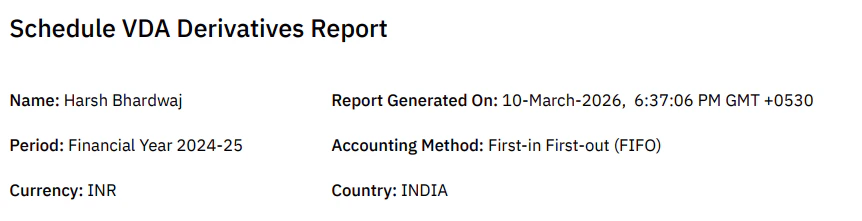
2. Schedule VDA Derivatives Transactions
This is the main section of the report, listing all realised derivatives trades during the financial year. Each row represents a settled derivatives position.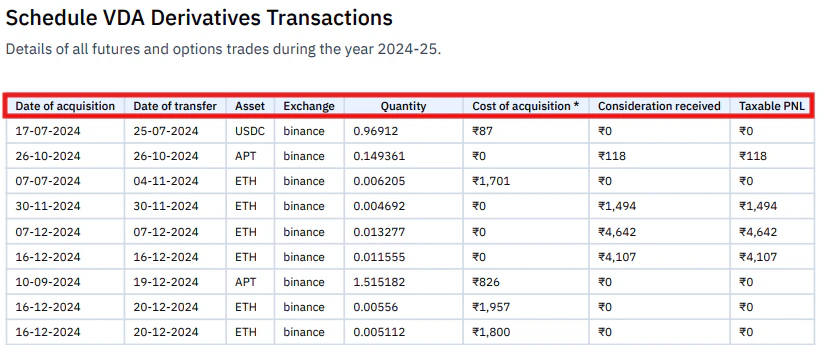
Columns in the Report
Example Transactions
Each row represents a realised derivatives trade during the financial year.
Understanding Taxable PNL
Taxable PNL represents the realised profit or loss from a derivatives position when it is closed.
This value represents the net profit or loss generated when the position was settled.
Important Notes in the Report
Cost of acquisition excludes brokerage: The Cost of Acquisition column does not include brokerage or exchange trading fees. These fees are excluded from the calculation unless your tax settings offset brokerage in trades. Date of transfer represents realised PNL: The Date of Transfer column represents the date when the derivatives position was closed and the profit or loss was realised. This date is used for reporting purposes. Derivatives reporting may require professional advice: Crypto derivatives transactions may be declared under Schedule VDA only after consultation with a CA or tax professional. Depending on your activity level, derivatives income may also be treated as business income.Do You Need Both VDA Reports?
If you trade both spot and derivatives:
The Complete Tax Report for India consolidates all activity, but these reports help your CA review the data separately.
Why Some Trades Appear in the Derivatives Report
KoinX categorises transactions based on exchange account data. Included in the Derivatives Report: futures account trades, perpetual contract settlements, and leveraged positions. Included in the Standard VDA Report: spot account trades, direct crypto purchases or sales, and DEX swaps. If a trade appears in the wrong report, check the exchange integration source. Classification comes directly from exchange APIs.Frequently Asked Questions
Do I need this report if I only trade spot crypto?
Do I need this report if I only trade spot crypto?
No. Spot trades are captured in the Schedule VDA Report.
Why are some trades in the derivatives report and others in the standard VDA report?
Why are some trades in the derivatives report and others in the standard VDA report?
KoinX classifies transactions based on exchange account types. Futures account trades appear in the derivatives report, while spot account trades appear in the standard report.
Does Cost of Acquisition include trading fees?
Does Cost of Acquisition include trading fees?
No. Brokerage and trading fees are not included in the cost value in this report.
What does Taxable PNL represent?
What does Taxable PNL represent?
It represents the realised profit or loss when the derivatives position was closed.
Why does Cost of Acquisition show ₹0 for profitable trades and Consideration Received show ₹0 for loss trades?
Why does Cost of Acquisition show ₹0 for profitable trades and Consideration Received show ₹0 for loss trades?
This happens because crypto derivatives trades are settlement-based contracts, not direct asset purchases like spot trades. Exchanges report derivatives settlements differently: for a profitable trade, the realised profit is recorded as consideration received with cost shown as ₹0. For a loss trade, the realised loss is recorded in the cost column with no consideration received. This reflects the contract-based nature of derivatives rather than a traditional buy-sell structure.